Answer 05 · Style comparison
Art Deco vs Art Nouveau
One curves like a vine, the other steps like a skyscraper. Separated by a generation, confused ever since.
Look at the line. Art Nouveau (c. 1890–1910) flows: asymmetrical whiplash curves, vines, flowers, and figures drawn from nature. Art Deco (c. 1920s–1930s) snaps: symmetry, zigzags, chevrons, sunbursts, and stepped profiles borrowed from the machine age. Organic and curving means Nouveau; geometric and stepped means Deco.
The two styles bracket the First World War, and the war is the hinge between them. Art Nouveau was a turn-of-the-century attempt to invent a new art from natural forms — Tate's glossary dates its peak to 1890–1910. Art Deco, named after the 1925 Paris Exposition Internationale des Arts Décoratifs et Industriels Modernes, embraced instead the glamour of machines, speed, and industry. Same decorative confidence, opposite instincts.
Side by side
| Feature | Art Nouveau | Art Deco |
|---|---|---|
| Peak years | c. 1890–1910 | c. 1920s–1930s |
| Signature line | Flowing, asymmetrical "whiplash" curve | Crisp geometry: zigzag, chevron, sunburst |
| Inspiration | Nature — vines, flowers, insects, the female figure | Machines, speed, jazz, ancient Egypt and the Americas |
| Composition | Asymmetrical, organic, hand-drawn | Symmetrical, stepped, repeatable |
| Materials | Wrought iron, stained glass, carved stone, ceramics | Chrome, stainless steel, smooth masonry, bakelite, glass block |
| Typical buildings | Town houses, cafés, metro entrances, department stores | Skyscrapers, cinemas, hotels, apartment blocks, factories |
| Famous examples | Victor Horta's Hôtel Tassel (Brussels, 1893); Hector Guimard's Paris Métro entrances | Chrysler Building (New York, 1930); Miami Beach's Art Deco district |
| Also known as | Jugendstil (Germany), Sezessionstil (Vienna), Stile Liberty (Italy), Modernisme (Barcelona) | Style moderne; late streamlined phase called Streamline Moderne |
Reading Art Nouveau on a building
Art Nouveau rarely shapes the whole mass of a building; it lives in the details. Look for ironwork that grows like a plant — balcony rails, door grilles, and window guards with tendril curves — plus carved floral stone around entrances, stained or curved glass, and lettering that flows as if handwritten. Because it was expensive, handcrafted work, it concentrates on street-facing showpieces: shopfronts, doorways, and the occasional flamboyant town house. In Britain and the US it is scarce; Brussels, Paris, Vienna, Prague, Riga, and Barcelona hold the richest streetscapes.
Reading Art Deco on a building
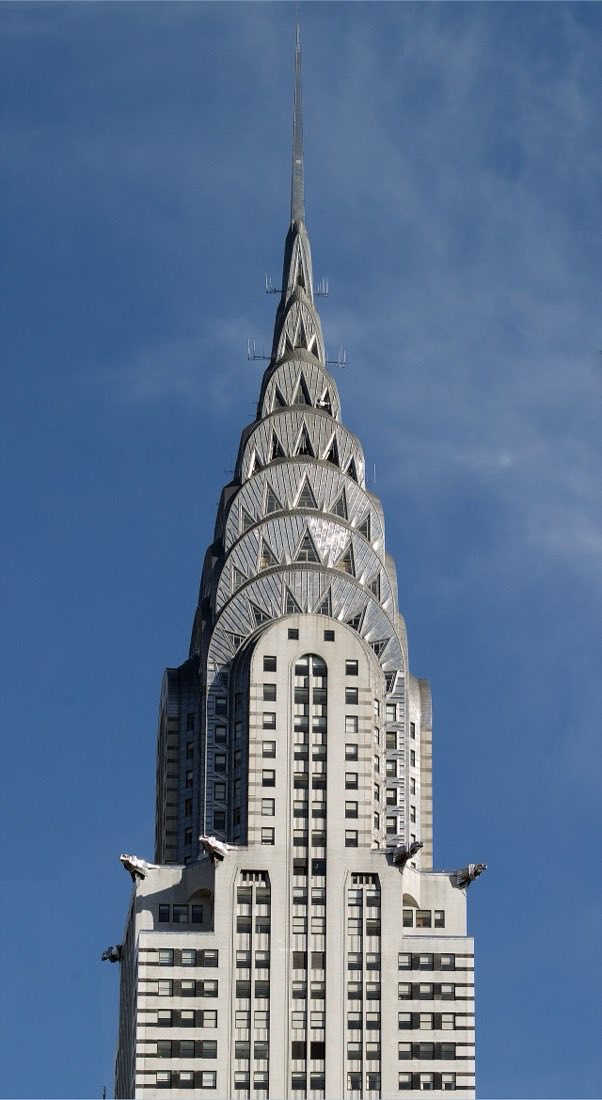
Art Deco does shape the whole building: stepped or ziggurat profiles, strong vertical emphasis, and symmetrical fronts. At street level, look for sunburst and chevron motifs over doors, fluted or reeded panels, geometric metal grilles, and stylized low-relief sculpture. The late-1930s Streamline Moderne variant swaps the zigzags for smooth curves, porthole windows, and horizontal speed lines — still geometric, never botanical. Unlike Nouveau, Deco was industrially reproducible, which is why cinemas, apartment blocks, diners, and factories across the world carry it.
Why the two blur together
Three honest reasons: both names start with "Art"; both are decorative styles from the same few decades of the early 20th century; and both appear on the same building types in the same city centres. There is also a real transitional zone — late Nouveau work tightens toward geometry, and some 1920s buildings mix floral relief with stepped massing. When a façade genuinely mixes both, date it by the composition: if the overall form is symmetrical and stepped, it is Deco wearing Nouveau jewellery.
Want the full timeline these two sit inside? Our beginner's guide to architectural styles places them among Georgian, Victorian, Modernist, and the rest — or photograph the building and let the Building Lore app read it for you.
Common questions
What is the main difference between Art Deco and Art Nouveau?
The line. Nouveau flows with asymmetrical, plant-like curves; Deco snaps with symmetry, zigzags, chevrons, sunbursts, and stepped profiles.
Which came first?
Art Nouveau, roughly 1890–1910. Art Deco followed in the 1920s–1930s, named after the 1925 Paris Exposition des Arts Décoratifs.
Is the Chrysler Building Art Deco or Art Nouveau?
Art Deco — its stepped, sunburst stainless-steel crown is pure geometry, with none of Nouveau's botanical curves.
Did Art Nouveau turn into Art Deco?
Not directly. Nouveau had largely burned out by the First World War; Deco answered the same appetite for decoration with an opposite, machine-age vocabulary. Some transitional 1910s–20s work shows both instincts at once.
Sources and methodology
- Tate, Art Nouveau — definition and dating of the movement.
- Victoria and Albert Museum, Art Deco collections — the style's origins around the 1925 Paris Exposition and its materials.